






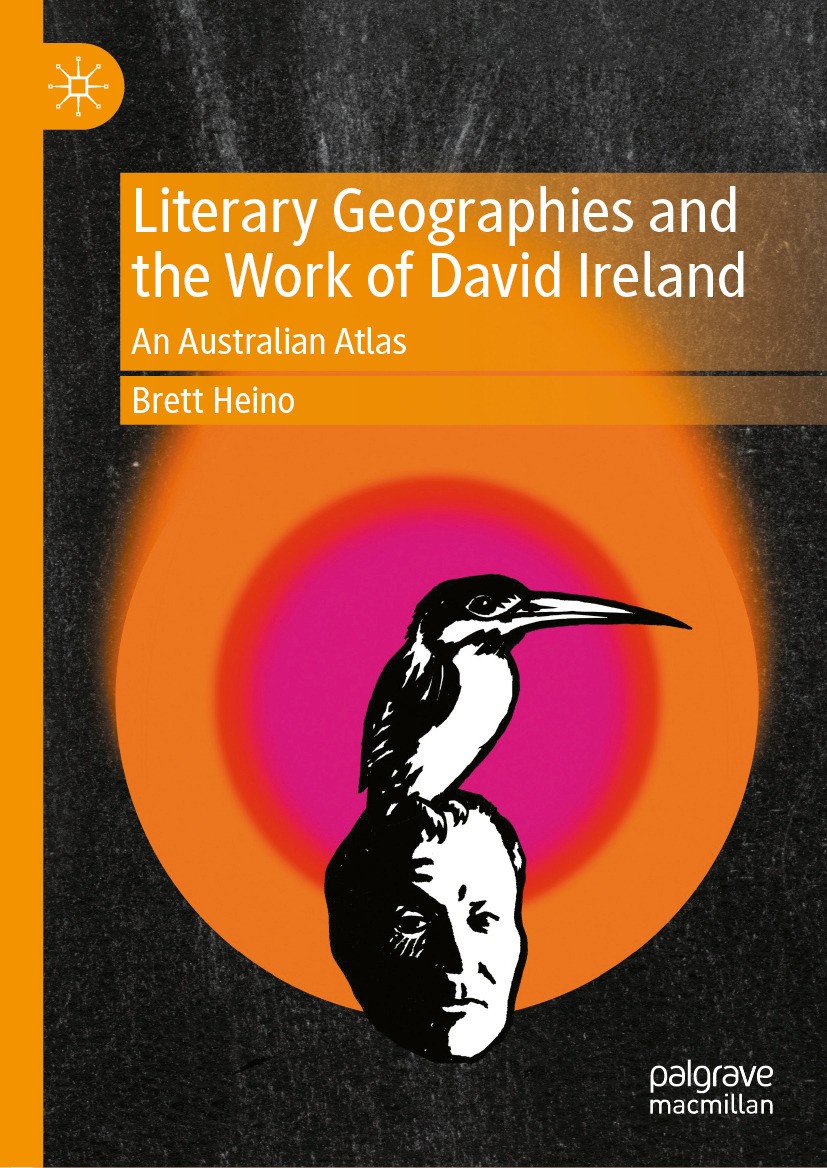
Launched on 31 October 2025 at Gleebooks, Sydney, this post focuses on the book by Brett Heino, Literary Geographies and the Work of David Ireland, which follows last week’s commentary from the same evening delivered by Brett Heino.
***
In acknowledging that we are on Gadigal land of the Eora Nation, I want to start by paying my respect to elders past, present, and emerging and also to those Indigenous peoples that are either in the audience or reading this commentary. Sovereignty in what is now called Australia was never ceded but, rather, violently dispossessed. In paying respects to Indigenous voices, I also want to draw inspiration from Tara June Winch’s novel The Yield (2019) that received, among others, the 2020 Miles Franklin Award. To cite one key passage:
Don’t know what it is about us that seems to rile the white man. The burden, the burden of their memory perhaps, or that we weren’t extinguished with the lights of those empires after all!
Born in Wollongong, Tara June Winch’s third book The Yield is about alternative notions of “the yield” of the land and the knowledge it creates. Her book is critical of the ideology of improvement and notions of economic productivity and resource extraction that land is regarded to yield in terms of profit. She is also critical of those who want to hold maps as equivalent to the actual place of country. It is these themes of Indigenous dispossession, space, and maps as abstractions of place that we will unpack tonight with Brett Heino’s book launch focusing on his Literary Geographies and the work of David Ireland.
In Literary Geographies and the Work of David Ireland, subtitled “An Australian Atlas”, Brett Heino (also from Wollongong) has delivered a classic book on political economy, space, and literature. It is highly original and offers a series of consistent contributions that people will engage with, use, deploy and build on. Today, I want to focus on two main contributions followed by five questions. From my vantage point, there are a series of contributions that Brett can celebrate and I want to share and amplify them with this audience. Equally, there are a set of questions for reflection, for Brett and us. Let’s get into it.
Contributions
The first central contribution Brett therefore makes is to advance the notion of the spatial unconscious that prevails within literary work. Fredric Jameson famously argued in The Political Unconscious (1981) that literature has a political unconscious: literature can work out and respond to the presence and absence of social contradictions and raise meaningful reflections about our everyday lives. Brett similarly advances that literature has a spatial unconscious: we can uncover the realised and unrealised lived, perceived, and conceived production of space in novels and their handling of its contradictions. Citing his earlier book Space, Place and Capitalism (2021: 51): “we can see through a text’s spatial unconscious its recording of the contradictions and articulations of space and place”.
In my view, opening up perspectives on the spatial unconscious of literature is the most original and profound contribution of Brett’s book and it is pathbreaking. He combines thinkers such as Fredric Jameson and Henri Lefebvre to get to the spatial unconscious. Yet Brett adds clarity, power, and depth to the concept of the spatial unconscious that is really far reaching and wide-ranging. I cannot wait to build on it, use it, reference it, and extend it through application.
The spatial unconscious is shaped throughout the book by Brett in relation to David Ireland’s work by asking two key questions:
- What is the nature of the geographic knowledge embedded in literature?
- How does literature inform the construction and reproduction of space and place?
Literary texts are thus a handling, a working, a refraction and a questioning of ideology, dealing at the same time with the structures of economy, space, and place.
We receive from Brett a detailed mapping of the world of David Ireland across his entire literary output and a journey through an atlas of Australia that includes issues of Indigenous dispossession and survival, labour, capital, patriarchy, the state, the surplus population (or lumpenproletariat), and the rise of neoliberal authoritarianism.
The second central contribution is the periodisation of David Ireland’s literature that results from analysing the production and contradictions of space in his novels. This goes as follows:
- The left-nationalist phase of The Unknown Industrial Prisoner (1971) and Burn (1974);
- The neoliberal era of Archimedes and the Seagle (1984) and Bloodfather (1987); and
- The post-neoliberal authoritarian era of The Chosen (1997), The World Repair Video Game (2015), and the poem-like Time Capsule (2016).
What we have across this periodisation, then, is a focus on the remaking of capitalism across the landscape of Australia that reveals the central role of law in the constitution, maintenance and reproduction of economy, space, and the state. The novels therefore not only register this spatial transformation but create new knowledge about it.
Questions
In turning to my questions about the book and for Brett, there are five that I want to briefly unpack.
First, David Ireland is presented as the pre-eminent Australian novelist of space on page 4 of Literary Geography and the Work of David Ireland. My question here is simply: really? I would like some more consideration of this claim in relation to the novels of others, for example, of Alexis Wright, especially Carpentaria (2006) and, of course the novels of Tara June Winch with which we commenced. More controversially from a White Australia perspective there is Elenore Dark’s The Timeless Land trilogy (1941, 1948, 1953), or Patrick White in Voss (1957) where “Knowledge was never a matter of geography. Quite the reverse, it overflows all maps that exist”. Or Tim Winton in The Shepherd’s Hut (2018), where the question is “could anyone conjure up a landscape more penitential than this one?”, or Kenneth Cook in Wait in Fright (1961) and its schoolteacher “where Nature deposited the graces she so firmly withheld from the west”. Or we could come full circle and turn to Claire G. Coleman and the “war” on terror of colonialism in her Terra Nullius (2017). These are just a few examples of Australian literature. You will have more. My question here, then, is could we have some more contouring of David Ireland within the space of Australian literature to convince us that he is pre-eminent, surpassing all others, as an Australian novelist of space?
Second, David Ireland mixes genres from the gritty realism of industrial capitalism and the state in The Unknown Industrial Prisoner to the fantastic or magical realist text of City of Women, for example. The novelist that my own research is addressing in terms of the frontiers of economy and space is Cormac McCarthy, focusing on his U.S.-Mexico borderlands literature, such as Blood Meridian and The Border Trilogy. Indeed, McCarthy once quipped that he was not much of a fan of magical realism: “it’s hard enough to get people to believe what you’re telling them without making it impossible. It has to be vaguely plausible”. My simple question is, then, does Brett consider David Ireland’s mix of rather opposed genres both convincing and successful?
Third, sticking with genre, Mark Fisher in Capitalist Realism argues that there are capitalist realist authors (e.g. James Ellroy) that ‘pose as unflinching observers who refuse to prettify the world’ so that it cannot be fitted into simple binaries e.g. good and evil. The ‘realism’ is underscored with ‘luridly venal’ fixation and ‘the hyperbolic insistence on cruelty, betrayal and savagery’. Hence, should David Ireland be considered within a pantheon of capitalist realist novelists (alongside Cormac McCarthy, too), especially given Fisher’s critique that capitalist realism has a ‘super-identification with capital’, which is where Ireland seems to land in terms of the above periodisation of state and capital?

Fourth, a question on synthesis. Calls to synthesis always make me nervous. Not because of an attachment to any sort of purity but usually because a move towards synthesis quite often seeks to mask or obscure difference or the purpose lying behind the synthesis. In Literary Geographies, then, Brett offers a synthesis between Henri Lefebvre (French Marxist philosopher of economy and space) and Louis Althusser (French Marxist philosophy of capital and ideology). Sounds like a perfect match. What could go wrong between a blend of two French Marxist philosophers? I would suggest, perhaps, a great deal. Afterall, Lefebvre rejected the entire edifice of Althusser’s concept of ideology and viewed Althusser as the “brainless” ideology of the state and Stalinism. There are hints of this in the Anglophone literature in The Production of Space (1974) where Maurice Blanchot is the easy target or substitute for Althusser, with Blanchot in The Space of Literature (1955) accused of reading space into literature too readily and fetishising it. ‘The problem’, Lefebvre states in The Production of Space, ‘is that any search for space in literary texts will find it everywhere and in every guise: enclosed, described, projected, dreamt of, speculated about’. But this is mild in comparison to Lefebvre’s entire book targeted against the Structural Marxism of Althusser. In Au-delà du structuralism [Beyond Structuralism] published in 1971 there is the essay ‘Les paradoxes d’Althusser’ [The Paradoxes of Althusser] that was first published in 1969. This source was also translated into Spanish as ‘Las paradojas de Althusser’, in Henri Lefebvre, Estructuralismo y política [Structuralism and Politics] in 1973, where Lefebvre states:
Structuralist ideology envelops the fetishism of space. For it, the flow of time gets bogged down in actual space, like a river flowing toward a motionless sea that loses itself in a delta of mud and swamps (1971: 416; 1973: 228).
For obvious reasons, then, a Lefebvre-Althusser synthesis is deeply problematic. This is not only an issue about mixing theoretically incommensurable approaches. It also goes to the heart of politics. One French Marxist philosopher remained within the Parti communiste français (PCF: French Communist Party) for over 40 years until his death (Althusser). The second French Marxist philosopher was suspended and then expelled from the PCF in 1958 for criticisms of its politics on the Algerian War of Independence, among other issues, and his heterodox critical attacks on existentialism, structuralism, and its apologia for Stalinism (Lefebvre). This raises some affinities between Henri Lefebvre and Georg Lukács on the power of truth and ideology in relation to the Party form, as discussed here.
What, then, is the pay-off and cost of the synthesis at the heart of Brett’s book? If the goal is to focus on the agents of abstract space in the novels of David Ireland—such as Sibley in The Glass Canoe—why not take recourse to Antonio Gramsci? This was, after all, somebody that Lefebvre positively engaged with and drew from, notably in The Production of Space. Surely Gramsci’s understanding of organic intellectuals, the struggle for hegemony, and the theory of the extended state is a strong departure point for considering class agents with the wider state and ideological hegemony of capitalism than the formula of Althusser’s Ideological State Apparatuses?
My fifth and final question is that Brett argues that, ‘it is only through the ideological working of literature that we can hope to understand the totality of the process’ of capital’s spatial effects (page 168). Put simply, how about the spatial unconscious of film, music, sport, theatre and more? Could we have some measure of the significance of literature but within a wider unfolding of the material structure of ideology, theory of the state, and the political economy of capital?
Conclusion: how many maps?
To conclude, questioning the relation between territory and map has long been present throughout contributions on economic and spatial analysis. There is Joan Robinson’s witticism in Essays in the Theory of Economic Growth that ‘a model which took account of all variegation of reality would be of no more use than a map at the scale of one-to-one’. This reminds me of Alfred Korzybski’s earlier quip in Science and Sanity that ‘a map is not the territory it represents, but, if correct, it has a similar structure to the territory, which accounts for its usefulness’. As Marx advises in volume 3 of Capital:
all science would be superfluous if the form of appearance of things directly coincided with their essence.
Lewis Carroll or Jorge Luis Borges could be similar alternative sources moving from economic thinking to literature on the map-territory relation. Of course, there is also Lefebvre himself in The Production of Space asking: ‘How many maps, in the descriptive or geographical sense, might be needed to deal exhaustively with a given space, to code and decode all its meanings and contents?’
How many maps might we need to deal exhaustively with the given space of Australia, to code and decode all its meanings and contents? Who knows?
But in Brett Heino’s atlas of Australia produced from the world of David Ireland we have an outstanding compass.



Comments